

I-275 Commuters: When Your Oil Change Interval Stops Matching Your Miles
Highway miles, cold starts, and Michigan stop-and-go each rewrite the calendar your owner's manual assumes.
Every weekday morning, a river of taillights moves north on I-275 toward the office parks of Farmington Hills and south toward the hospitals and factories closer to Livonia. Plymouth sits at a geographic sweet spot: close enough to the interchange that a ten-minute delay still beats surface-street alternatives, far enough from Detroit's core that many drivers rack up true highway miles before their first coffee cools. That driving profile is exactly what oil-life monitors and owner's manuals struggle to describe. A sticker that says ten thousand miles between changes may be prudent for gentle Arizona cruising and dangerously optimistic for a cold-start-heavy Michigan commute with idling in the Sheldon Road merge lane.
How I-275 Miles Differ From What Monitors Measure
Modern oil-life systems count engine revolutions, temperature cycles, and sometimes load—but they cannot smell short trips to Meijer on Beck Road after an overnight freeze. Cold starts leave fuel dilution in the crankcase; condensation forms when the engine never reaches full operating temperature. A Plymouth driver who covers forty interstate miles each way still makes cold starts twice daily unless they work from home half the week. Those starts consume additive packages faster than steady-state cruising. Turbocharged engines, increasingly common on Metro Detroit commutes, add heat stress during acceleration lanes merging from I-96 or M-14. The manual's longest interval assumes temperate climates and consistent highway operation; West Wayne County delivers neither from November through March.
Fleet data from the region tells a consistent story: vehicles serviced at six- to seven-thousand-mile intervals show cleaner valve train deposits and fewer timing-chain tensioner failures than identical models stretched to ten thousand. Synthetic oils extend protection, but they do not suspend physics. Particle accumulation from EGR systems and direct injection still requires removal at the drain plug. For drivers crossing the I-275 corridor between Northville and Canton daily, treating oil changes as time-and-mileage events—not mileage alone—aligns better with reality.
Oil change stickers on windshields still matter for households where multiple drivers share one vehicle and nobody watches the dash oil-life percentage. A visible date written in grease pencil survives phone upgrades and app logins forgotten after three years. Plymouth advisors often reconcile sticker history with onboard monitors during first visits, resolving conflicts in favor of whichever signal indicates dirtier oil—because conservative drains cost less than bearing damage on a cold March morning leaving for a Livonia shift.
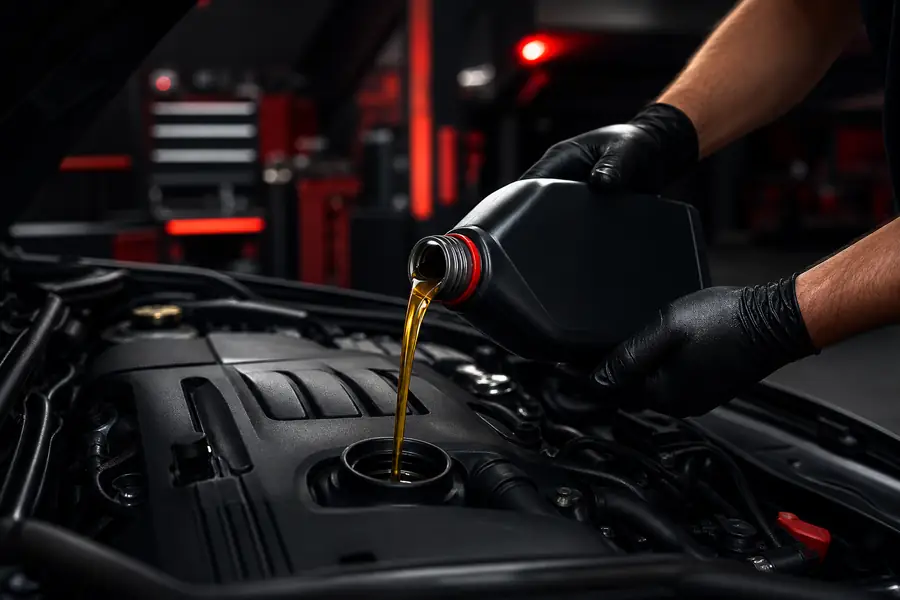
Severe Service in a Mild-Looking Commute
Manufacturers bury a 'severe' maintenance schedule in the back of the manual; most Plymouth buyers never read it. Severe conditions include frequent short trips, extended idling, dusty roads, and trailer towing—categories that describe suburban life more than cross-country touring. Idling in the Michigan Left turn queue on Ann Arbor Road counts. So does creeping through school zones near Plymouth-Canton schools before jumping onto the freeway. Dust from construction on I-275 expansion projects elevates air intake contamination. Labeling these habits severe is not an upsell; it is an acknowledgment that oil shear accelerates when engines spend more minutes below optimal temperature than above it.
The longest interval in your owner's manual was written for a driver who rarely faces a February cold start on Sheldon Road— not for an I-275 commuter leaving Plymouth at 7 a.m.
Choosing Oil Weight and Type for Four-Season Commuting
Zero-weight synthetic oils improve cold-flow during January mornings without sacrificing summer viscosity on hot August afternoons stuck in freeway construction. Dexos-approved formulations matter for General Motors vehicles assembled down the road; Mopar and Ford specifications matter equally for the domestic mix common in employee parking lots off I-275. High-mileage blends with seal conditioners help aging commuter cars past the hundred-thousand-mile mark common before trade-in. What matters most is consistency: the same specification at every change, proper filter cut-open inspection when metal appears in the drain, and torque-spec drain plugs that do not strip aluminum pans—a frequent repair when quick-lane technicians overtighten.
Signs Your Interval Is Too Long
Oil color alone misleads; dark oil can still lubricate if additives remain active. Better signals include rising oil consumption on the dipstick between fills, a gasoline smell on the dipstick after repeated short trips, and lifter tick at startup that fades as the engine warms. Check-engine codes for cam phaser or variable valve timing often trace to neglected oil changes on engines that needed fresher viscosity. Turbo whine that grows louder may indicate coked bearing supply lines. Plymouth drivers who track fuel economy sometimes notice a two- to three-mile-per-gallon drop when friction increases inside neglected engines.
Building a Schedule That Matches Your Route
A practical framework for I-275 commuters starts with six months or six thousand miles, whichever arrives first, for conventional and synthetic-blend oils. Full synthetic can stretch toward seven thousand five hundred when at least half of weekly miles are steady highway above fifty miles per hour. Add a thousand-mile reduction if most trips begin cold and end within ten minutes. Log changes in the glove box or phone app; oil-life percentages on the dash are guides, not gospel. Pair every oil service with a tire rotation—commuter tires wear shoulders faster on curved freeway ramps—and a fluid level check on transmissions that work harder in stop-and-go merges.
Used buyers shopping Craigslist and Facebook Marketplace around West Wayne County should treat undocumented oil history as a discount factor, not a bargain. Sludge visible under valve covers on a low-mileage garage queen often means years of deferred changes between short downtown Plymouth trips and occasional highway runs to visit family in Northville. A pre-purchase oil analysis costs less than one missed interval and reveals fuel dilution, coolant intrusion, and bearing metals that predict expensive repairs. Sellers with receipts from a consistent Plymouth shop command higher prices because interval discipline is verifiable.
Wear Master Auto Super Center in Plymouth calibrates oil change recommendations to the routes customers actually drive: I-275 north to Novi, south toward Metro Airport, or west toward Brighton. Matching interval to commute keeps the engine that powers your merge lane departure as reliable as the timing you have honed over years on the same corridor.